
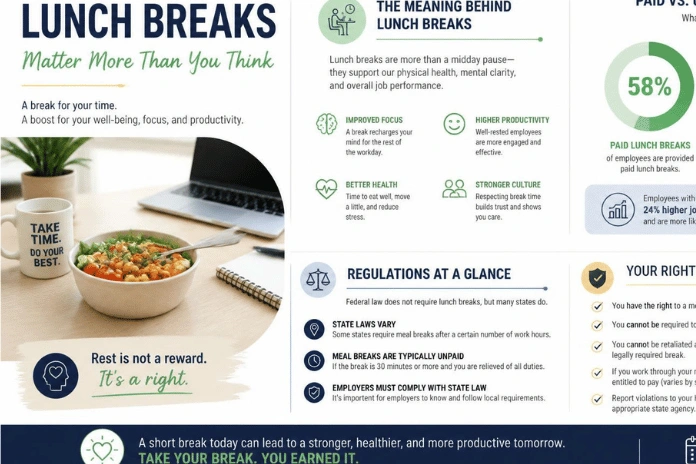
A lunch break gives you a scheduled pause from work to eat, rest, and reset before the second half of your day. Its length, payment status, and legal requirements can differ by employer and location.
In the United States, federal law does not require employers to provide meal periods. State laws may create additional rights, so workers should check the rules that apply where they work.
| Key question | Quick answer |
| What is it? | A pause during the workday for a meal and personal time |
| Typical length | Often 30 to 60 minutes |
| Is it federally required in the U.S.? | No |
| Is it always paid? | No; bona fide meal periods may be unpaid. |
| Are short breaks paid? | Federal rules generally treat 5- to 20-minute rest breaks as paid work time. |
| Do state laws matter? | Yes, requirements vary by state. |
| Why take the break? | Eating, mental detachment, movement, and workday recovery |
Direct answer: A midday meal period is time set aside during a workday for eating and recovery. In the United States, federal law doesn’t require employers to provide one, although state rules may. A bona fide meal period typically lasts at least 30 minutes and may be unpaid when the employee is fully relieved of work duties.
What a Lunch Break Means at Work
The basic idea is simple. You stop performing your normal duties for a set period around the middle of your shift. A dictionary defines it as the period during the day when a worker stops working to have a meal. In practice, workplace policies can make the situation more complex.
Lunch break: One employer may provide 30 unpaid minutes. Another may schedule a full lunch hour. Some employees have flexible meal periods, while others must take them at set times. Your company handbook, employment agreement, union contract, and local labor rules can all affect the arrangement.
How Long Should a Meal Break Be?
There is no single length that applies to every worker. Thirty minutes is common because U.S. federal guidance distinguishes bona fide meal periods from short rest periods. The U.S. Department of Labor’s guidance on breaks and meal periods states that meal periods typically last at least 30 minutes.
A 60-minute period gives you more time to eat away from your workstation, walk, run an errand, or decompress. Whether that extra time is useful depends on your schedule and whether it extends your workday.
Some states set their own minimum duration and timing requirements. California, for example, has meal-period rules for many employees who work more than five hours. Other states use different thresholds. Because these rules vary by jurisdiction and occupation, check your state labor department before relying on a general article.
Paid vs. Unpaid Meal Periods
Federal rules make an important distinction between a short rest break and a genuine meal period. Short breaks of about 5 to 20 minutes are generally treated as compensable work time when an employer provides them. Those minutes count toward hours worked.
A genuine meal period usually works differently. It can be unpaid when you are relieved of work duties and can use that period for your own purposes.
That means eating while continuing to perform assigned work can change the situation. If you’re expected to keep handling calls, serving customers, or completing tasks, you may not be receiving a bona fide unpaid meal period. Specific wage questions should be checked against current state rules or discussed with a qualified employment professional.
Are Employers Required to Provide One?

Under the federal Fair Labor Standards Act, employers generally do not have to provide meal or rest periods to adult workers. State law can provide stronger protections.
The Department of Labor’s state meal-period table lists requirements in 21 states and other jurisdictions. That table was last revised on January 1, 2023, and the department advises workers to confirm current requirements with the relevant state labor office.
Rules can also depend on:
- The employee’s age.
- Shift length.
- Occupation or industry.
- Collective bargaining agreements.
- State-specific exemptions.
Employers should make their policies clear in writing. This helps workers understand timing, clock-in procedures, interruptions, and whether meal time is compensated. Clear workplace policies also support broader hiring and retention practices. Inrockry’s guide to talent acquisition strategies offers related ideas for organizations managing employees.
Why Stepping Away From Work Matters
A meal period isn’t useful only because you need food. It also provides a chance to detach from work mentally. A peer-reviewed study followed 841 Finnish workers across 11 organizations. Researchers found that psychological detachment and a sense of control during midday recovery were linked to better recovery experiences. Successful recovery was also associated with lower exhaustion and greater vigor one year later.
The study shows an association, not a guarantee, that any specific activity will improve performance. Still, it supports a practical point: spending the whole period thinking about unfinished work may reduce the restorative value of your time away. Rest outside working hours matters too. Inrockry’s article on noise and sleep quality covers another part of the recovery picture.
How to Use Your Midday Break Better
A useful lunch break doesn’t need a complex routine. The goal is to create some separation between your morning tasks and your afternoon workload.
For 30 minutes, try this simple structure:
- Disconnect for the first five minutes. Step away from email, work chats, and your active task.
- Give yourself time to eat. Avoid turning the entire meal into another meeting whenever possible.
- Change your surroundings. Move to a break room, outdoor area, café, or another suitable space.
- Move for a few minutes. A short walk can provide a physical change after prolonged sitting.
- Use the final minutes to reset. Decide which task deserves your attention when you return.
You don’t have to maximize every minute. A midday pause is allowed to feel like a pause. Remote workers can use the same principle. Leaving the desk may matter even more when the workplace and home share the same space.
Teams managing distributed work may also benefit from systems that reduce unnecessary interruptions. Inrockry’s guide to future-proofing a business tech stack discusses tools and infrastructure to improve efficiency.
Common Mistakes That Make Breaks Less Restful
The first mistake is continuing to perform normal duties while treating yourself as off the clock. That can create both recovery and wage issues. Another mistake is spending the entire period responding to work notifications. You may stop typing, yet your attention never leaves the job.
Other habits worth avoiding include:
- Scheduling every meal as a work meeting.
- Delaying food until late in a long shift.
- Staying seated in the same position all day.
- Regularly skipping scheduled time off.
- Assuming the policy is identical in every state.
Your ideal routine will depend on your job. A nurse, warehouse worker, office employee, driver, and remote designer may all face different constraints.
Conclusion
A lunch break at work is more than simply time to eat. It provides employees with an opportunity to step away from their duties, have a meal, recover mentally, and prepare for the rest of the workday. While a 30-minute meal period is common, there is no universal rule covering every worker.
In the United States, federal law generally does not require employers to provide meal breaks to adult employees, but state laws can impose additional requirements. The difference between a paid short rest break and an unpaid bona fide meal period is also important, particularly when an employee is expected to continue working while eating.
Frequently Asked Questions
Not always. Under U.S. federal guidance, bona fide meal periods are generally not compensable work time. Short rest breaks of about 5 to 20 minutes are generally paid when provided.
Not under federal law for most adult workers. State laws may require one based on shift length, occupation, or other conditions.
An employer can assign work, but if you perform duties during a supposedly unpaid meal period, that time may not qualify as such. Federal guidance distinguishes genuine meal periods from compensable work time.
That depends on state law and company policy. A worker may not always be allowed to waive a legally required period or change scheduled hours without employer approval.
Eat, step away from work demands, change your surroundings when possible, and give your mind time to disengage. Research suggests that psychological detachment and control over break time are connected with better workday recovery.