
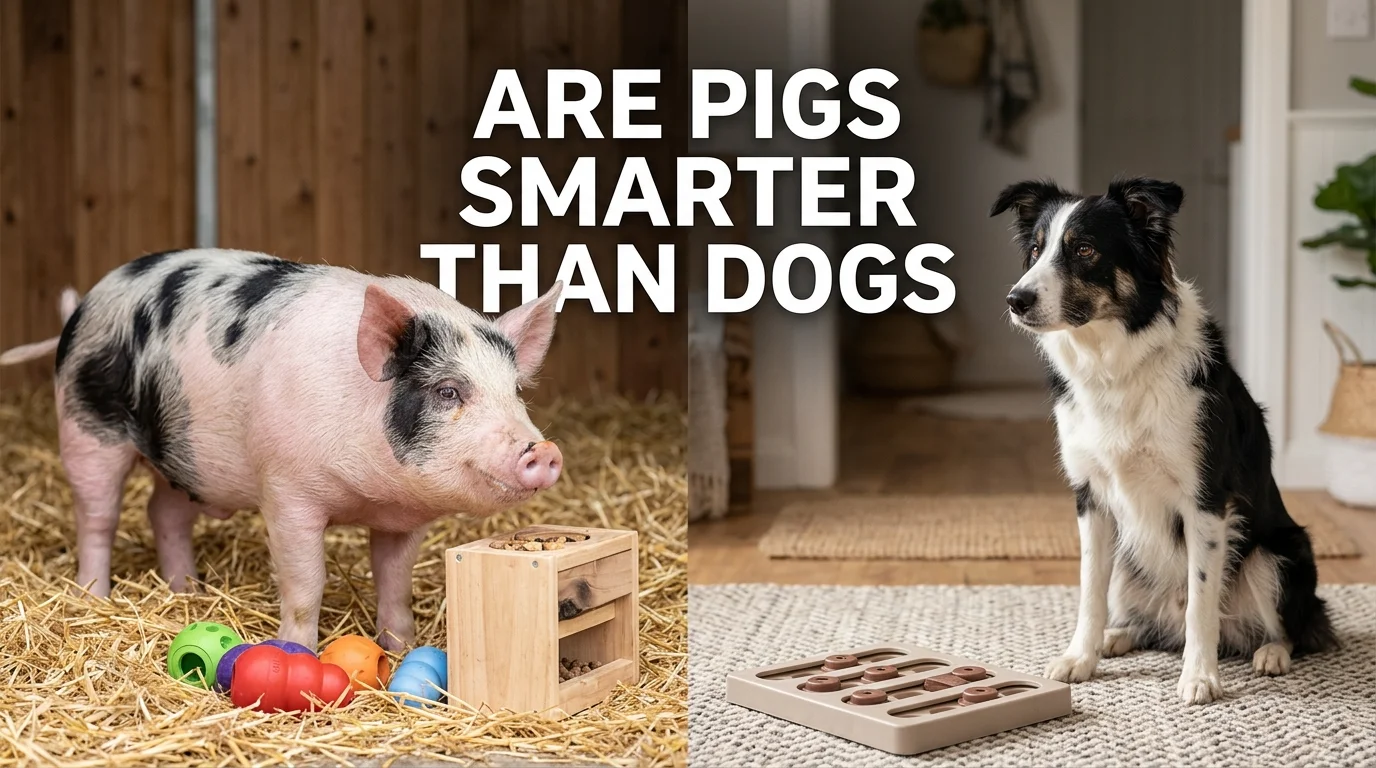
The question “are pigs smarter than dogs” sounds simple, but animal intelligence doesn’t have a single score. Research shows strong cognitive skills in both species, with different strengths. Pig cognition often shines on its own, while dogs excel at reading and engaging with humans.
Short answer: No validated animal IQ test makes one species universally smarter. The pig can solve some physical tasks quickly, while dogs use human social cues more spontaneously. The answer changes with the skill tested, task design, and each species’ evolutionary history.
| Cognitive area | Pig | Dog | What research suggests |
|---|---|---|---|
| Independent problem-solving | Strong persistence and learning | Strong, but often more human-oriented | A pig may excel on some independent tasks |
| Human pointing cues | Less spontaneous | Particularly strong | Clear canine strength |
| Unsolvable problems | Often keeps working independently | More likely to seek human input | Different strategies |
| Learning and memory | Well documented | Well documented | No universal winner |
| Human attachment | Social with people | Strong owner-specific attachment | Canine strength |
| Novel computer task | Can learn joystick-controlled targets | Not directly compared in that study | Shows cognitive flexibility |
| Overall intelligence | Domain-dependent | Domain-dependent | No single scientific ranking |
TL;DR: What the Evidence Tells Us
- Pig cognition includes impressive learning, memory, persistence, and novel-task abilities.
- Dogs have notable strengths in human pointing, gaze, communication, and attachment.
- Direct pig-dog studies often involve small samples, so one experiment cannot establish overall intelligence.
- Popular claims comparing animal minds with human toddler ages oversimplify how cognition is measured.
Are Pigs Smarter Than Dogs? What Research Actually Shows
Scientists usually compare specific cognitive abilities rather than giving animals a universal intelligence score. Learning, memory, communication, spatial skills, and problem-solving can produce different results. Reviews of both species therefore caution against treating intelligence as one simple ladder.
A direct 2021 study offers a useful example. Ten miniature swine and 12 family dogs learned to open the same apparatus. During solvable trials, the swine group averaged 6.5 seconds, compared with 12.8 seconds for dogs.
The pattern changed when researchers made the problem impossible. Dogs became more human-oriented, while the other group showed less human-directed behavior. That difference suggests distinct problem-solving strategies rather than a simple intelligence hierarchy.
Seven Research-Backed Findings Behind the Comparison

1. Independent problem-solving can favor the pig
The 2021 apparatus study found faster average performance from the porcine group during solvable trials. The animals also spent less time manipulating the apparatus during initial testing. Those results show efficient independent problem-solving within that particular experiment.
2. Dogs understand human pointing more spontaneously
A 2019 experiment compared highly socialized miniature swine with family dogs. Only dogs spontaneously used a sustained human pointing gesture to choose between locations. The other animals developed a side preference instead of following the gesture.
This difference matters because people often judge animal intelligence through human interaction. A dog that follows your finger immediately appears exceptionally clever. Yet the test mainly measures sensitivity to a human social signal.
3. Dogs communicate with humans differently during difficult tasks
Researchers have also tested whether companion animals direct people toward unreachable rewards. Both species noticed humans, yet dogs showed clearer referential communication when both the person and reward were present. That finding again points toward a specialized canine advantage in human-directed communication.
More recent work has continued examining orientation between humans and inaccessible targets. Dogs generally showed more frequent orientation changes than their porcine counterparts. The evidence supports meaningful species differences in how they recruit people during problems.
4. A pig can learn a joystick-controlled video task
A 2021 Purdue University study trained four animals to operate a joystick using their snouts. Moving the joystick controlled a cursor displayed on a computer screen. All four performed above chance on first attempts with one-walled targets.
The experiment was especially demanding because the subjects faced physical disadvantages. Their vision and limited dexterity made joystick use harder for them than for primates. Researchers still found evidence that they learned the relationship between joystick movement and screen movement.
5. Mirror research shows why single studies need caution
A famous 2009 experiment produced striking results with a mirror. Seven of eight mirror-experienced animals located hidden food using reflected information. The researchers argued that the subjects learned how the reflection related to their surroundings.
A later replication produced much weaker results. Only two animals in one group and one in another successfully used the mirror. The authors concluded that mirror use might sit near the upper limit of what these animals can do.
These conflicting results illustrate an important research lesson. A surprising cognitive achievement should be replicated before becoming a broad claim about an entire species. Intelligence comparisons deserve the same caution.
6. Learning and memory are well established
A major scientific review found extensive evidence for learning and memory abilities in domestic swine. Researchers have studied discrimination learning, spatial tasks, memory, and other cognitive processes. The literature supports a much more complex mind than old livestock stereotypes suggest.
That does not automatically place the animal above a dog. Canines also show strong learning and memory across many experimental settings. What differs most noticeably is often how each species applies those abilities.
7. Dogs have a distinctive attachment advantage with humans
A 2024 Scientific Reports study compared young companion animals raised in similar human environments. Dogs showed stronger owner-specific attachment patterns under the Strange Situation Test. Their porcine counterparts did not meet the same attachment criteria.
The study does not mean one species lacks social feelings. Instead, it suggests canine domestication produced distinctive behavioral tendencies toward human caregivers. Those tendencies make dog intelligence especially easy for people to recognize.
Why Dog Intelligence Often Looks More Familiar
People have spent generations selecting dogs for cooperation, work, companionship, and responsiveness. Modern family dogs therefore pay remarkable attention to human behavior. Pointing, gaze, voice, and social feedback can become important information sources. Elsewhere on the site: Are Coyotes Dogs.
This specialization shapes everyday impressions of intelligence. A dog may look toward its owner when a problem becomes impossible. An independently persistent animal might keep working without asking for help, even if it understands the problem equally well.
For more dog-focused lifestyle content, Inrockry also has a guide to dog-friendly cottages and traveling with a canine companion. Broader animal articles are available through the Inrockry Pets section.
Why Animal IQ Rankings Can Be Misleading
Cross-species tests can unintentionally favor one animal’s body, senses, or evolutionary background. A pointing experiment rewards attention to human gestures. A joystick experiment introduces vision and motor requirements that may disadvantage another species.
Sample size creates another limitation. Several influential direct-comparison studies involve relatively small groups of companion animals. Their findings reveal useful patterns, but they do not create a universal IQ ranking.
The popular claim that a farm animal has the intelligence of a three-year-old child has the same problem. Human developmental age is not a standardized measure of animal intelligence. Different species solve different ecological and social problems using abilities suited to their lives.
What These Findings Mean for Animal Owners
High intelligence does not automatically make an animal easier to live with. Clever animals need appropriate enrichment, predictable routines, training, and chances to explore. Boredom can become a management problem when an inquisitive animal lacks suitable activities.
Pet owners should therefore think beyond labels such as “smart” or “stubborn.” Observe what motivates the individual animal and how it learns. Inrockry’s 10-week-old kitten care guide shows the same principle with another companion species.
Frequently Asked Questions
Are pigs smarter than dogs overall?
Science does not support one universal winner across every measure of cognition. A pig can perform strongly in independent learning and problem-solving tasks. Dogs show notable advantages when a task involves interpreting or communicating with humans.
Can a pig be trained like a dog?
The animal can learn associations, cues, routines, and complex trained behaviors. Joystick research also shows the ability to learn an unfamiliar relationship between physical movement and a screen target. Training style should still reflect the species’ motivations and natural behavior.
Does a pig have a better memory than a dog?
Research clearly supports substantial learning and memory abilities in the pig. Evidence does not establish that its memory is universally better across every comparable task. Memory itself includes spatial, working, recognition, and long-term components.
Why do dogs often seem smarter to people?
Dogs are exceptionally responsive to human social information. Experiments show advantages in following pointing gestures and communicating during difficult tasks. Humans can easily notice those talents during everyday interactions.
Is the “as smart as a three-year-old child” claim accurate?
That phrase should be treated as a loose analogy, not an IQ result. Scientists test specific abilities instead of assigning animals a human developmental age. Cognitive strengths also vary greatly across tasks and species.
The Bottom Line
Both species are intelligent, but their strengths take different forms. The pig shows impressive independent learning, memory, persistence, and cognitive flexibility. Dogs are especially skilled at turning human behavior into useful information.
That distinction is more informative than declaring a universal winner. When you compare the task being tested, the research becomes much clearer. For more animal behavior and pet-care reading, continue through Inrocketry’s Pets coverage.


