

An ecommerce SEO case study is most useful when it explains what changed, how long growth took, and which actions produced results. Recent U.S. examples show that category pages, technical fixes, stronger product content, and internal links can drive measurable gains. The strongest studies also connect rankings with traffic, orders, or revenue instead of reporting positions alone.
A useful lesson appears across several recent campaigns. Growth rarely came from one clever tactic or a few blog posts. Stores improved important commercial pages, fixed technical barriers, and kept working long enough for those changes to compound.
Direct answer: Recent U.S. ecommerce case studies show meaningful organic growth can take several months to more than a year. Strong campaigns improve category pages, technical health, internal linking, product content, and alignment with search intent. The biggest gains usually come from making valuable shopping pages easier for customers and Google to find.
Ecommerce SEO Case Study at a Glance
| Area | What Recent U.S. Case Studies Show |
|---|---|
| Primary market | United States |
| Common platforms | Shopify, BigCommerce, WooCommerce |
| Main growth pages | Category, collection, product, comparison, and guide pages |
| Common technical work | Indexing, redirects, duplicate URLs, crawlability, structured data |
| Typical measurement | Organic traffic, rankings, revenue, clicks, orders |
| Time required | Several months to more than one year |
| Main lesson | Commercial pages need technical access, useful content, and strong internal links |
Key Takeaways
* Category and collection pages often provide the strongest commercial SEO opportunities.
* Technical improvements matter most when they help important pages get crawled and indexed.
* Internal linking helps search engines understand page importance and relationships.
* Search intent should shape category content, buying guides, and comparison pages.
* Revenue and qualified traffic matter more than isolated keyword positions.
* Short campaigns can show movement, but sustained growth often takes longer.
Ecommerce SEO Case Study Results: What the Numbers Show
A 2026 DigiAssets case study followed a U.S. Shopify fashion and sportswear store over 18 months. Reported monthly organic Google revenue rose from \$884 to a peak of \$69,757. One use-case-focused category page also reached 33,038 monthly Search Console impressions.
A separate TJA Strategies campaign involved a commercial cleaning products manufacturer selling hundreds of products online. The agency reported 113% more searches ranking on page one during its measured comparison period. It also reported a 60% increase in searches reaching Google’s top three positions.
Searchbloom published a BigCommerce example showing estimated U.S. organic traffic rising about 43% within four months. Page-one keyword counts reportedly increased 44% during the engagement. The case study clearly separates Ahrefs estimates from Google Search Console click data.
Cravo Marketing provides a longer-term example involving 80 tracked U.S. desktop keywords. Estimated monthly visits increased from 28 in January 2024 to 1,784 by August 2026. The company notes that 79 tracked queries were non-branded, making the growth particularly relevant for customer acquisition.
These figures come from agencies describing their own engagements, so they shouldn’t be treated as universal benchmarks. Different stores face different competition, margins, product catalogs, technical problems, and brand awareness. Their value comes from the recurring patterns behind the reported gains.
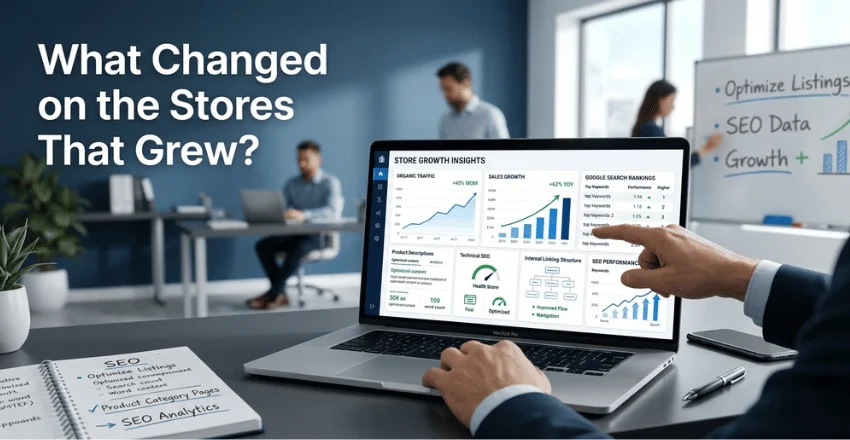
What Changed on the Stores That Grew?
1. Category Pages Became Search Assets
Several successful campaigns focused heavily on category or collection pages. These pages sit close to a purchase while targeting broader searches than individual products. They can attract shoppers who know what product type they need but haven’t chosen a model.
The DigiAssets example highlights a category organized around shopper intent rather than warehouse terminology. TJA Strategies also rebuilt important categories as part of its campaign. These examples suggest that merchandising structure and search behavior should work together.
Store owners should review whether category pages answer basic buying questions. Useful copy can explain differences, use cases, compatibility, sizing, materials, or selection criteria. It should help shoppers choose, not just fill space beneath a product grid.
2. Technical SEO Supported Revenue Pages
Technical work appears repeatedly in successful store campaigns. Examples include redirect management, indexation fixes, duplicate URL cleanup, heading improvements, and navigation changes. These tasks matter because a strong product page cannot rank consistently if search engines struggle to access it.
Google recommends simple, descriptive URLs and warns about unnecessarily complex parameter combinations. This advice matters for stores using filters, sorting options, or faceted navigation. Poor controls can create many similar URLs and waste crawling resources.
Technical work should still connect with commercial priorities. Fixing every possible warning can consume months without affecting valuable pages. Start with problems that block important categories, products, or buying guides.
For a broader explanation of page-level and external ranking work, Inrock’s on-page versus off-page SEO guide provides useful background. That distinction helps teams separate store improvements from authority-building activities. Both can matter, but they solve different problems.
3. Internal Linking Makes Important Pages Easier to Find
Large stores often contain strong pages buried several clicks from the homepage. Internal links can connect supporting guides, categories, subcategories, and products more clearly. They also help visitors continue from research into shopping.
The Jenson USA case study credits category optimization, internal linking, and duplicate URL fixes as key improvements. More than 120 commercial keywords reportedly moved from positions eight through ten into the top three. Category pages were described as the primary growth lever.
Internal linking works best when anchors describe the destination naturally. A buying guide might point toward the most relevant category rather than a generic homepage. Category pages can also link toward useful comparisons or supporting education.
Inrockry already groups marketing material within its Digital Marketing section. That type of topical organization can help readers discover related material. Ecommerce publishers can use the same principle around products and buying topics.
Why Search Intent Matters for U.S. Ecommerce Stores
A shopper searching “best running shoes for flat feet” expects different information from someone searching a specific shoe model. The first query needs comparison and selection help. The second may require price, availability, specifications, reviews, and shipping information.
Search intent should therefore influence which page type targets each keyword. Informational topics can support guides, while commercial terms often belong on category pages or comparison pages. Transactional product searches generally need strong product or collection pages.
Google’s people-first content guidance asks whether visitors leave feeling they learned enough to achieve their goal. It also warns against publishing across many topics primarily to attract search visits. Those principles make intent matching more important than repeating keywords.
This approach can also support content promotion. Inrockry’s guide to AI, digital PR, and content marketing campaigns discusses campaign ideation and distribution. Ecommerce teams can apply similar planning when promoting original guides, research, or product resources.
Product Content Still Needs Useful Detail
Manufacturer descriptions rarely give an ecommerce store a meaningful search advantage. Competitors may publish the same specifications and wording across dozens of domains. Unique product content should answer questions that help buyers decide.
Useful details can include sizing guidance, compatibility, materials, care instructions, warranty conditions, or differences between variants. Reviews and original photography can provide additional context. The exact additions depend on the product and what customers need before buying.
Google supports product structured data that can help search systems understand product information. Supported markup can also make products eligible for richer search presentations. Eligibility does not guarantee that a rich result will appear.
Google has also expanded documentation around product variants and merchant information over time. Store owners should follow current documentation rather than relying on old schema checklists. Search features and supported properties can change.
A Practical 90-Day Ecommerce SEO Plan
A case study is useful only when its lessons turn into action. A U.S. store can start with a focused 90-day program instead of changing everything at once. The order below prioritizes diagnosis, commercial pages, and measurable improvements.
1. Audit indexation and crawlability. Check whether important categories and products appear correctly in Google Search Console.
2. Identify high-value category pages. Prioritize categories tied to meaningful demand, margin, inventory, and purchase intent.
3. Map keywords by intent. Separate informational, commercial, comparison, and product-specific searches.
4. Improve category content. Add useful selection guidance, FAQs, comparison details, and links toward important products.
5. Strengthen product pages. Replace duplicated copy and answer common buying questions with original information.
6. Fix internal linking. Connect guides, categories, subcategories, and products using descriptive anchors.
7. Review URL parameters. Control unnecessary filtered and sorted URLs that can create crawl problems.
8. Implement relevant structured data. Validate product and breadcrumb markup against Google’s current documentation.
9. Publish supporting content. Target questions that naturally lead readers toward products or categories.
10. Measure business outcomes. Track non-brand clicks, qualified sessions, conversions, revenue, and important rankings.
Ninety days may reveal early movement, but it is not a guaranteed finish line. Several current case studies show growth continuing for many months. Expectations should reflect competition, site history, technical condition, and implementation speed.
How to Judge an Ecommerce SEO Case Study
Not every impressive percentage tells you something useful. A 300% increase from ten monthly visits creates a different business outcome from 30% growth on a large store. Good case studies provide enough context to interpret the headline.
Look for a clear baseline, measurement period, market, platform, and metric source. Check whether the results concern branded searches or new customer discovery. You should also see what work happened before the improvement.
Pay attention to revenue or conversions when those figures are available. Traffic growth can look impressive while bringing poor-fit visitors. Commercial SEO should ultimately contribute to profitable customer acquisition.
Finally, distinguish measured data from estimates. Search Console, analytics platforms, ecommerce systems, and third-party SEO tools measure different things. The Searchbloom case study does this well by identifying which metrics came from estimates.
What U.S. Ecommerce Teams Can Learn From These Examples
The strongest lesson is not that every store should copy one campaign. The lesson is that consistent fundamentals repeatedly appear alongside measurable growth. Category quality, technical access, internal links, useful content, and patient execution work together.
A sound ecommerce SEO case study should therefore help you prioritize rather than promise identical results. Use the examples as evidence for testing specific improvements on your own store. Measure results against your baseline and commercial goals.
For U.S. stores, competition often includes major marketplaces, established retailers, and specialized niche brands. Winning does not require ranking for every possible search. It requires improving visibility for searches connected with products customers can profitably buy.
Frequently Asked Questions
What is an ecommerce SEO case study?
An ecommerce SEO case study documents the search work completed for an online store and the results observed afterward. Strong examples include baselines, timelines, tactics, and measurable outcomes. They may report traffic, rankings, revenue, orders, or conversions.
How long does ecommerce SEO take to show results?
There is no fixed timeline for every store. Current examples show meaningful movement occurring within months, while stronger growth can continue beyond a year. Competition, technical problems, site authority, inventory, and implementation speed all affect timing.
Which ecommerce pages should be optimized first?
Start with pages that combine business value with realistic search opportunity. Important category and collection pages often deserve early attention because they target commercial searches. Product pages become especially important for specific models, brands, or high-intent queries.
Are blog posts enough to grow an ecommerce store?
Blog content can help, but it should support the shopping experience. Commercial category and product pages still need strong content, technical SEO, and internal links. A blog that attracts unrelated traffic may provide little commercial value.
Should ecommerce SEO focus on traffic or revenue?
Track both, but connect traffic with business outcomes. Non-brand clicks can show whether new shoppers are discovering the store. Revenue and conversions show whether that visibility reaches people likely to buy.
Turn the Case-Study Lessons Into a Store-Specific Plan
Start by choosing a small group of valuable categories rather than rebuilding the entire store. Measure their current clicks, rankings, conversions, and revenue before making changes. That baseline gives you something meaningful to compare later.
Then improve technical access, category usefulness, internal links, and supporting content around those pages. Review performance monthly instead of reacting to daily ranking changes. Keep what improves qualified traffic and sales, then apply those lessons to the next group of pages.


